Friday, April 8, 2016

Awake my Soul

Coming home from a retreat is often a slam back to reality.  And even the most profound insights get lost under the laundry, dirty dishes and to do lists.  This retreat was all about incorporating rest or whitespace into daily life in very practical ways, and I'm determined to follow through and pursue the presence of God through whitespace.

It's seems somewhat ironic to me that the method to awaken my soul is to be quiet! Noise to me is not just about sound but about inputs.  Noise can be words, can be social media, can be email and can also be people asking me questions, can be the radio or can be TV.  Quiet for me is closing down those input, and that is what brings me rest.

The other day I realized I was in a room alone and could anticipate an hour free from interruptions.  Instead of grading chemistry tests, checking email, or working on the project due by the end of the week, I indulged in meditating on scripture via the WordSwag app.  At first I felt guilty, but then I realized that reading and re-reading the words, choosing a photo for the background, and switching out fonts until I found one with the right 'feel' allowed me to dwell on the verses in a different way.  The resulting images speak to my soul.  The process gifted me with 30 minutes of unexpected soul rest.


Tuesday, December 8, 2015

Advent and Paradox


(I wrote this while listening - over and over.)
The Piano Guys "O Come, O Come, Emmanuel"


A sadness permeates me this advent.  I know the reasons – life…sin. But the ache begins to resemble a longing.  And the cello in The Piano Guys “O Come, O Come, Emmanuel” cries my longing.

Yes, this is a season of joy.  But waiting for the coming of Christmas, of the coming of Christ, is also a longing time.  2000 years ago they waited for freedom from captivity.  We are not so different, only our captivity is different.  They longed to be free, we long to be free, and so we should.

The kingdom is here and not yet.  Paradox.  Christ came and brought freedom to captives.  The freedom He offered in the flesh 2000 years ago was not what people expected.  Similarly the freedom He offers today is frequently not what we expect or what we plead for.  We live in a world of sin and suffering, with an enemy that seeks to steal, kill and destroy.

For the first time, my observance of advent is more focused on the longing than any of the trappings of Christmas.  We will decorate.  We will celebrate.  But the joy and sorrow of this year, the changes, the stumblings, the growth, are all tangled together leaving me overflowing with paradoxical emotions.

Come, Lord Jesus is a cry and a comfort.  I begin to understand that I’m waiting, not just during advent, but I’m waiting for much longer and for much more than the coming of Christmas. For Christ’s return.  For a new world.  For complete freedom. 

I rejoice that I’m finally grasping part of the bigger picture.  I shouldn’t be too comfortable here because this is not my home.  As I live and work and love and laugh and weep and struggle I SHOULD be longing.  For the first time I don’t just sing the words, but I FEEL the words.  Come, please come, Emmanuel.  God with us.

Monday, November 2, 2015

The Motivation behind the Oracles

"My heart cries out for Moab" Isaiah 15:5

In these oracles we should never forget that all people are God's people.  He loved and loves not only Judah and Israel but ALL men - Assyrians, Philistines, Moabites, Egyptians, Cushites, etc..  He warns for the purpose of repentance.  His intent is always redemption and salvation for all.

This is true even today.  He doesn't force repentance, but He does graciously and repeatedly extend the opportunity.

I wrote this on a Sunday morning, and then our pastor preached on Jonah.  Is this the only prophetic book that records a repentance?  Jonah prophesied about 40 years before Isaiah.  Ninevah was in Assyria, the enemy that was pounding on Judah's door during the time of Isaiah.  Evidently, the Assyrians were cruel beyond belief, so cruel that Jonah's unwillingness to go there is understandable in human terms.  

Unlike the 66 chapters of Isaiah's prophecies, we have one line from Jonah.  

"Yet forty days and Ninevah will be overthrown."

Maybe he said more and it's not recorded.  Maybe he just spent a day walking the city and shouting this prophecy.  What happened next illustrates for us the reason God sent prophets.

"Then the people of Ninevah believed in God... (and the king issued a proclamation) 'Let men call on God earnestly that each may turn from his wicked way and from the violence which is in his hands.  Who knows, God may turn and relent, and withdraw His burning anger so that we shall not perish?' When God saw their deeds, that they turned from their wicked ways, then God relented concerning the calamity which He had declared He would bring upon them.  And He did not do it." Jonah 3:5,8-10

This is the heart of God!!  Jonah defines it for us later on (even though he's complaining).

"For I knew that you are a gracious and compassionate God, slow to anger and abundant in lovingkindness, and one who relents concerning calamity." Jonah 4:1

I believe this is God's hope and desire for all nations and all people.  This is why He sent prophets, and this is why Isaiah wrote the oracles against the nations.  God's desire was that the nations would hear the warning, believe in God, and repent.  

As we were reminded in chapter 14, what God intends will stand.  His intent is repentance and His desire is to 'relent concerning calamity.' But God holds back from forcing repentance.  He does not grab us and slam redemption into our chests, forcing us to embrace it.  He offers.  He warns.  He knows ahead of time who will accept and who will reject.  I believe He grieves.

"My heart cries out for Moab."  And Assyria.  And Israel.  And Judah. 

And Iran.  And ISIS.  

"For you, Lord, are good, and ready to forgive, and abundant in lovingkindness to all who call upon You."  Psalm 86:5

Who is God?

After chapter 13, I leap at the first words of chapter 14! "The Lord will have compassion ... and will choose." Me! I'm reading this with my name substituted for Jacob's.  Never forget that no matter how great God's wrath and anger appear when He is punishing for sin and wickedness, His compassion for His children is equally as great.  

It's somewhat unique that much of this chapter is written as a taunt that reveals attitudes as well as events.  I find verses 13-14 most revealing.

"But you said in your heart, I will ascend to heaven; I will raise my throne above the stars of God... I will make myself like the Most High."

Matthew Henry says the following: "It is a gracious ambition to covet to be like the Most Holy, for he has said, Be you holy, for I am holy; but it is a sinful ambition to aim to be like the Most High, for he has said, He that exalteth himself shall be abased, and the devil drew our first parents in to eat forbidden fruit by promising them that they should be as gods."

We should strive to be holy as God is holy, but we must never strive or put ourself in a position to try to be God.  This may seem obvious, but I'm not confident I'm in the clear.  Does my pride ever lead me to judge what God does as faulty?  Do I ever think I have a better plan than what I see God doing? Do I ever reject God's ways?

I don't think I'm likely to raise a throne or a banner to myself or consciously proclaim myself to be like God.  But I feel I need to be watchful of the heart attitudes that creep in and lead me to consider myself the sole authority and the one with the best ideas.  When I grumble about what God is doing, perhaps I need to check my heart and make sure I'm not acting as the clay berating the potter.

I more frequently fall into this when I see things happening around me that I conclude can't possibly be the will of God.  But look at verses 24 and 27.

"Surely, just as I have intended so it has happened, and just as I have planned so it will stand."

"For the Lord of hosts has planned, and who can frustrate it?"

The times that I doubt God's plans are the times I must be careful not to think of myself as God or more highly than God.  When I think I could run things better.  When I suspect God is impotent. When I doubt God's goodness as I look at circumstances.  

This is hard!  Divorce, illness, death, financial devastation, floods (literally!), fire, job loss.  How do I reconcile the plans of God with the things that from my perspective seem solely destructive, negative or full of evil?

I believe that this is why knowing the character of God is crucial.  When we can't see the goodness of God, we need to be able to remember who He is.  From our study so far in Isaiah, here is what I have gleaned about God's character:

-God always has a plan for redemption.
-God is for the poor, the widow, and the orphan.
-God is for justice and righteousness.
-God invites us to walk with Him.
-The Lord alone will be exalted.
-The Lord is holy.
-God is with us.
-God is light, salvation, strength, song.

He planned it.  It will stand.  He is good.  

That's all I have to stand on.

Thursday, October 29, 2015

Isaiah 12

Hanging this on my wall and reading it aloud while I slog through the oracles ;-)

Wednesday, October 28, 2015

Isaiah 13 - the First of the Oracles

We are diving into some difficult chapters now, the oracles against the nations.  There are days that I have to remind myself, why exactly am I studying Isaiah?

If I believe that all scripture is inspired by God, I have to believe that ALL scripture is inspired by God.  That means Isaiah too including all the chapters on judgment and coming destruction.

With that settled, how do I approach these chapters?  I offer two suggestions that helped me not be discouraged by chapter 13.  Go back and reread chapter 12.  In fact, reread chapter 12 after each of the next 10 chapters at least. 

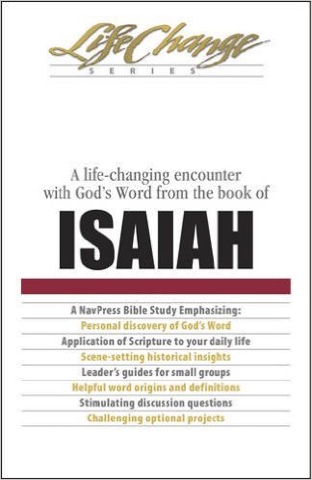
I'm using three primary resources while studying Isaiah, besides different Bible translations.  This book has been the most valuable of the three.

 I stumbled over it in a box of books someone gave me to donate for them.  What a gift from God just for me!  The second is  Matthew Henry's Commentary on Isaiah found free online.  It's a lot to wade through but provides good insights.  The third is Walvoord's Bible Knowledge Commentary which fills in a lot of the unfamiliar historical information.  I guess a fourth would be my Strong's Concordance app.
 
I'm also asking the same question I have been: what does this teach me/reveal to me about the heart of God?  Even chapters that dwell on what God hates reveal to me in the process the things God loves.  Additionally, I can ask what the passage reveals to me about people.

A fast reading through chapter 13 in the Message reminds me:
Judgement belongs to the Lord.
God's power is greater than I could ever grasp.
God WILL take care of things in the end.  He has a plan and He has it under control.
I should never take God lightly.  Fear of the Lord is a real thing.  (Maybe I need to reflect more on that.)
Things God does not tolerate: sin, evil, pride.

This oracle against Babylon is directed at the most important city in the Assyrian empire as well and the capital of the empire that will conquer Assyria.  Babylon is also a symbol of world empires opposed to the Lord. (Rev. 17-18)

The Lord of hosts is mustering a host for battle.  The description that follows is either thrilling or terrifying depending on your point of view.  I don't want to be on the wrong end of the Lord's weapons of indignation!  But if our Defender strikes such fear in those who oppose us, what do we EVER have to be afraid of!  I see this theme of who we should fear being repeated in Isaiah.   Do you fear the Assyrians? The Philistines?  Do I fear a certain presidential candidate? My boss? Terrorists? Disease?

God's wrath is not indiscriminate.  He is slow to anger, abounding in lovingkindness and gives countless opportunities for repentance.  Yet His holiness demands justice for sinners, punishment for evil and wickedness, and an end to arrogance.  We who live under the New Covenant need not fear his wrath.  Yet we should not make the mistake of thinking God has relaxed his standards of holiness.  His holiness is the same; His justice demands that sin be punished.  The description of wrath we read in chapter 13 is the full wrath Jesus took for us.  Maybe that will help us consider that sacrifice a little differently.

Tuesday, October 27, 2015

The Wells of Salvation

“With joy you will draw water from the wells of salvation.”
Isaiah 12:3  

I've been surprised to discover that salvation is a theme of Isaiah.  I think of salvation as a New Testament concept, but in the beginning of chapter 12 the word is used three time including the image of the 'wells of salvation.'

The word for wells means a fountain, a spring, a well, or my personal favorite, a source of satisfaction.  The Old Testament if full of imagery related to wells, springs and fountains.    
-springs in the midst of valleys
-fountains of living water
-a fountain shall come forth
-fountain of life

In a desert land water is literally life.  In Bible times, water determined where you lived and how you travelled.  If the spring dried up, you moved because death came quickly without water.  Although I know that I need water to live, I take it for granted.  I rarely if ever feel an urgency about water, or my urgency is based solely on the thirst of the moment.  

These illustrations have lost some potency for us because we haven't experienced the thrill of water in the desert.  I've even lived in the desert where I ALWAYS travelled with water, but I still never had a time I couldn't get my hands on clean water for a few coins.  In this current age, we live disconnected from the spring that keeps us, our family and our livestock alive.  We have never lived with the dependence on a well for our physical salvation.

Do I live with this kind of dependence on the Lord? He IS the source of life, but just as I take for  granted the clean water flowing on command as I turn the faucet, do I also take salvation for granted? Do I go daily to the well to draw? Do I experience joy related to the well of salvation? I can relate to the satisfaction of a cold glass of water when I'm hot, tired and thirsty.  Where is my source of satisfaction when my spirit is tired and thirsty?  Do I remember the well?